Monday, 2 October 2017

SABRATHA KILLINGS 1.10.207 ETC.

The killing of two dignitaries of the Beni Oualid clan last Friday was in addition to the deadly fighting that rival groups have held for two weeks at Sabratha, killing 26 and injuring 170 others. Facts of concern for Algeria and other neighboring countries.
Since the beginning of 2016, the migratory crisis has exploded and, with it, the fear of terrorism. An obsession that the successive events in France, Belgium and Germany have unfortunately underpinned. It should be remembered that at the time Interpol announced that Daesh had 250,000 Syrian and Iraqi virgin passports, and that, according to Europol, 3,000 to 5,000 were to integrate the migrant cohorts at the gates 'Europe. From there to openly amalgamate the migratory flows and the terrorist threat, there was only one step, happily crossed by some EU countries that did not digest the rider alone of German Chancellor Angela Merkel when she "invited one million Syrians, overcoming the Schengen visa. The fact is that the phenomenon has reached such a magnitude and that the flow has concentrated in neighboring Libya, where traffic has become a very lucrative activity, to the point of arousing a strong reaction from the GNA of Fayez al Serraj but also from the authorities from the east. The strong recrudescence of immigrant candidates, after having swept across the Greek and Bulgarian borders, turned to the Italian coasts via Libya, to the extent that Rome has multiplied the grievances and pressures to obtain a "right of Libyan territorial waters. In 2016, Frontex planned to double the number of migrants (Sudanese, Eritreans, Malians and Somalis) from the Libyan coast to the European coasts, ie 300,000. Around 800,000 were already waiting in Libya, a number that adds to the 6 million displaced Syrians.In 2017, the victories over Daesh, both in Iraq and Syria, as well as in Sirte and Sabratha in Libya, triggered an ebbing of its fighters towards their country of origin but also towards Europe. This prompted the Berne Club (alliance of European intelligence) to warn against simultaneous attacks in several European capitals. As early as January 2017, Italy had put pressure on the GNA and on the authorities in the East to control severely the large-scale traffic that had developed, mainly in Sabratha, where most of the boats of migrants. Haftar who visited Rome last week, after an official visit to Tunis, handed over to the Italian Minister of Defense a list of war material (4x4, night vision sights, helicopters, etc.) to accomplish the task of surveillance of the South Libyan but it obtained only the assurance of a training of a few dozen elements to the requirements of security.It turns out that the war against the smuggling of migrants made Friday two victims, dignitaries belonging to one of the major clans of the country. On a mission of good offices to appease tensions between rival gangs, according to tribes of the region, they were machine-gunned on their return to Beni Oualid, 180 km south of Tripoli. The social council of the tribes of Ouarfella denounced the assassination of "Sheikh Abdallah Nattat, head of the reconciliation committee, Sheikh Khamis Isbaga and their two accompanying persons", followed immediately by the GNA who opened an inquiry and by the Parliament sitting in Tobruk. The killing of the two dignitaries took place at a time when deadly fights were rivaling rival groups in Sabratha, leaving 26 dead and 170 wounded. Algeria and other neighboring countries are worrying facts. It is clear that the situation remains complex enough to suggest that the solution would be within reach. The double journey made in April-May by Foreign Minister Abdelkader Messahel in the majority of cities was a necessary time in the mediation strategy led by the UN and the Group of Neighboring Countries. While Daesh was driven out of several cities such as Sirte and Sabratha, the fact remains that the smuggling of migrants, now fought by the GNA and the Eastern authorities, served as a breeding matrix for terrorism at multiple faces whose aims concern our country. Consequently, incessant diplomatic work cannot be seen as an ostentatious luxury because the stakes are paramount for the peace and security of the subregion. The meeting in Tunis last Tuesday of representatives of the Libyan rival parties has identified the complexity of the task, with the declared aim of reaching a "limited" amendment to the 2015 agreement to calm Marshal Haftar's ardor, Saleh Aguila, President of the House of Representatives and Abderrahmane Sweihli, President of the State Council, while maintaining a "legitimacy" of the GNA supported by the militias of Tripoli
including those of Haythem Tajouri and Abderaouf Kara. A long-term effort is therefore still needed for a political solution to be reached, an objective that Algeria is pursuing, against all odds, while providing unbiased support to all the parties involved in the inclusive dialogue , the only possible source of peace for the Libyan people.

PERSONAL COMMENT 
LIBYA HAD AN EXCELLENT CONSTITUTION IN 1951. SMALL MODIFICATIONS AND UPDATES MAYBE NECESSARY. THAT IS ALL.

Sunday, 1 October 2017

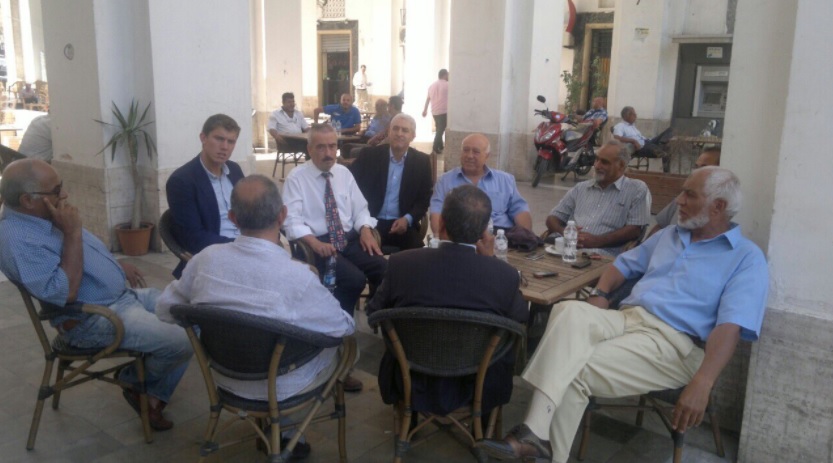
UK Ambassador mr Peter Millet notes 30.9.2017

I had coffee the other day in Algeria Square in central Tripoli.  I was passing by and was invited to sit with a group of men who kindly offered me some local coffee. It was a good opportunity to escape from the heat of the sun and hear their thoughts.
On Saturday I was in Benghazi.  Here, I decided to have tea.  Again, it was a chance to listen and learn.
You can’t understand a country unless you can meet people and find out what is on their minds.  In both Tripoli and Benghazi, the people I spoke to had similar concerns.  Number One is security.  In both cities, the situation is a calmer and quieter.   But it is fragile.  People are rightly worried about the return of violence, whether from terrorists, criminal gangs or militias.
The economy is also top of people’s agenda.  It is truly appalling to see long lines of people outside banks waiting patiently and with great dignity to try to get some cash. The black market rate of exchange and the rate of inflation also make the cost of living increasingly difficult. And the long power cuts are making life in many parts of the country a misery.
Life is tough for most Libyans.  Yet what they want is no different from what people want in any country: to live in peace, put bread on their family’s table, educate their children and know that they will be looked after if they get ill. Their designs, desires and demands are the same as those felt by any person in a coffee shop in London.
The 17 February revolution was supposed to bring some sort of new normality to life in Libya. Huge sacrifices were made to build a better life.
This was brought home to me dramatically by a man I met at Tunis airport who told me that both his sons were killed in the revolution, his wife died of a broken heart and his brother was killed by Daesh.  He called on me to stand by Libya.
Of course we stand by Libya.  We helped protect citizens in 2011 and we now want to help to bring peace and security to the Libyan people.
Appeals for us to help were part of our conversations in both Tripoli and Benghazi. The people I met all believe that we have a duty to help and can do more.
There is a tricky challenge here.  People demand support from the international community but rightly reject interference in their affairs. Of course: the future of Libya is for the Libyans to decide. But there is a fine line between interaction and interference.
The role of the international community is clear.  Interaction means facilitating contact between Libyans, encouraging agreement and then helping to implement it through the design and delivery of programmes to help improve the lives of Libyans.
We are already involved in delivering benefits. For example, we have funded the Stabilisation Facility for Libya that has allowed the Government of National Accord to deliver ambulances, fire engines, solar panels and other tangible benefits in Ubari, Benghazi, Kikla and Sirte.  This work will continue to help rebuild destroyed communities.
The same support applies at political level: we will support the new UN Special Representative Ghassan Salame to amend and implement the Libya Political Agreement.  He too will want to hear the views of Libyans and understand how best to meet the needs of the Libyan people.
Tripoli and Benghazi are the big cities.  I have also visited Misrata and Tobruq.  But I want to go further and meet men and women in all parts of Libya and hear their views. More coffee and tea is on the menu.

Saturday, 23 September 2017

WHITE LIBYA

"It is not easy to be blacks in Libya," said Noah, choosing his words carefully, and speaking in a low voice, though no one could hear us. We were sitting at the tables outside the Sky Bar in Tripoli. It was an afternoon of great heat and all customers were seeking shelter inside, with air conditioning. Noah comes from Niger, works at the bar with tasks rather vague, like any other foreigner in Libya, especially the blacks who come from neighboring African countries.
I agree with him, but in Libya do not admit it publicly, we continue to tell us that we are all equal in the sight of Allah, the Islam says, which in theory is true. But I, he and all the other black people in Libya know that the reality is very different, because we do not practice what we preach.
Noah took me a while 'before deciding that he could trust me and that he could speak freely. I had to spend long hours at the bar in the last two months, have a large and reliable source of good internet connection. Due to the long blackout in Tripoli, that table at the corner of the bar has become my office. Tripoli sank in the dark, desperate people were queuing outside the banks all day and slept there on the street overnight. The gas stations were besieged because of fuel shortages.
The militia commanders have purged Tripoli from any form of resistance
Reading the statements of some Italian officials of Tripoli, I find it misleading to say that here there are no mass demonstrations against the shameful agreement with Italy and the arrival of Italian ships in Libya. Obviously there are no demonstrations, and there will be none, but not because people approve of all this.
Who would complain? There have been rumors to the contrary. Many journalists have left Tripoli after they have been victims of threats, kidnappings and murders, and things are no better for activists. Who really keeps order in Tripoli, that militia commanders and not the puppet government, he has purged the city from any form of resistance or peaceful opposition. Words such as human rights and legality are absent from their vocabulary. The puppet government tacitly approves the actions of the warlords, there is just to sign what they require to sign, to dance on demand and live with the militias. They use the same old trick in Guide to govern Libya: "starves the dog and the dog will follow you."
Looks lowered
The situation is difficult for everyone, but for Noah things are even worse. The owner of the bar, like all the other owners of shops and bars in Libya, African blacks forcing workers to work hard for many hours a day. They do everything, from the first hours of the night morning anchor, clean the windows and tables, wash the floors, carrying boxes and equipment, they shop, wash their cars and perform any other task may be his assigned, according to the employers' whim work. How to pay, receiving small fractions of the minimum wage, and their passports are requirements as a form of insurance.
Another thing, very important: must always answer "yes sir", can not look the other person straight in the eye too long or refuse to execute an order. At any moment they can be kicked out kicking, sometimes literally. They sit by, invisible, they walk among us with his head down, when your eyes meet theirs, immediately distract the eye, and unless you do not smile or greet them will never turn the word first. They live in Libya as if they were in an elevator, embarrassed, avoiding any eye contact, silent until the elevator doors do not open. Only at that point they can not get out of the elevator and go back to being normal people.
Racism in Libya has very deep roots, is a part of our history that we tend to ignore and not from a generation long time will be grown without knowing it. Maybe today people are not fully aware, perhaps this is why we are likely to repeat it. I never managed to frame accurately these thoughts. Gloria instead knew exactly how to do it.
The history excluded from the history books
I was going to Venice for the premiere of The Order of Things . They had to go from Tunisia before heading to Italy. It was a year of great traffic, so I could not find a direct flight to Venice and I was forced to land in Rome and then to go to Padua, where I spent the night at the home of two of my friends, Gloria Carlini and Matteo Calore. Gloria graduated in socio-cultural anthropology and ethnology with a thesis on sex work and sexuality among young slum of Kampala. Since March of 2014 in the "Shadow of Slavery project in West Africa and beyond".
Gloria told me that there are missing parts of the story, parts of which today are not taught to children in school. You can not delete these chapters, or pretend they do not exist, just because we do not like. So it has taken on the task of telling the children what is excluded from the history books they use in school.
Article continues after ad
I agree with you, we all tend to amend the story, but in Libya we do very often, and not only with the early history, even with the most recent events. This is the case of serious clashes antimmigrati in 2000, calls slaves revolution , which, paradoxically, in our dialect means "revolution against the slaves." Crowds of angry people attacked and killed dozens of workers from African countries such as Ghana, Niger, Chad and Nigeria. From the town of Al Zawiya the riots have spread throughout the western region of the country, including Tripoli.
But we do not even great efforts to hide this feeling of hostility. In July the government based in Al Beida has established new tariffs for weddings: a Libyan who wants to marry a foreign woman has to pay five thousand dinars, a foreigner who wants to marry a Libyan woman has to pay three thousand dinars, for the Libyans who marry other Libyans the rates are 50 dinars. Whatever their justification, it is a punishment for those who do not want to marry a Libyan and a Libyan. Besides the new decree does not mention at all the possibility of granting the Libyan citizenship to children of a Libyan woman married to a foreigner.
I wonder if I'll find even Noah when he returned to Libya. We were never able to complete a conversation, they always interrupted, always had to go do something somewhere else: "Noah come here, go there, Noah, Noah brings this, Noah clean that." Sometimes I thought I would have to call it the "bar Noah."

Monday, 18 September 2017

LIBIA 18.9.2017

"Troppi cuochi in cucina rovinano il brodo", ha detto Ghassan Salamé, nuovo capo della missione di sostegno delle Nazioni Unite in Libia, al quotidiano italiano La Stampa all'inizio di questo mese, riferendosi a varie iniziative internazionali per portare la pace in Libia.

Certamente ci sono stati molti sforzi. A maggio, gli Emirati Arabi Uniti hanno ospitato un incontro tra il primo ministro del governo della Libia, Fayez al-Serraj, e il comandante dell'esercito nazionale libico, Khalifa Haftar. Il 25 luglio Haftar e al-Serraj a Parigi hanno firmato una dichiarazione congiunta a Parigi. Il 9 settembre si è tenuto un mini-summit dell'Unione africana sulla Libia in Congo-Brazzaville e sono stati anche riuniti olandesi-mediati tra parlamentari rivali e una presunta iniziativa di pace russa. Di tutti questi, Salamé era particolarmente a favore della riunione di Parigi.

Da parte sua, l'ONU spera di respirare nuova vita nell'accordo politico libico (LPA). Questo è stato firmato nel dicembre 2015 ma finora non è riuscito a far fronte alla crisi del paese. I dettagli del nuovo piano di Salamé - che prevedono di includere modifiche alla LPA - saranno rivelati questa settimana con una riunione sulla Libia prevista a fianco dell'Assemblea generale delle Nazioni Unite il mercoledì.

Mentre la frustrazione di Salamé è giustificata, le sue proposte rischiano di restare inefficace finché paesi come l'Egitto, la Russia, la Turchia, il Qatar, l'Italia e la Francia prestano servizio al PLA pur sostenendo le loro fazioni preferite sul terreno. La convergenza internazionale su ciò che il futuro della Libia dovrebbe assomigliare è necessaria prima che un affare operabile possa avvenire.

Un motivo per cui diversi attori regionali hanno seguito le proprie iniziative diplomatiche è l'inerzia dell'amministrazione di Trump in Libia. La presenza di segretario di Stato Tillerson la scorsa settimana in una conferenza organizzata dal Regno Unito per sostenere gli sforzi di Salamé è un passo nella giusta direzione, ma saranno necessari importanti paesi come l'Italia, l'Egitto, gli Emirati Arabi Uniti, la Turchia, la Russia e il Qatar al tavolo se un accordo UN-backed deve avere persino una possibilità remota di successo.

La dichiarazione congiunta molto celebrata firmata da Al-Serraj e Haftar a Parigi due mesi fa riconosce implicitamente il fallimento dell'APL nella sua forma attuale, è improbabile che porti fine al conflitto in Libia.

Mentre al-Serraj e Haftar rappresentano i principali rivali della Libia, c'è una miriade di milizie concorrenti e di gruppi tribali e di organizzazioni estremiste come il ramo libico dello Stato islamico. A Tripoli, il governo di Al-Serraj, sostenuto dalle Nazioni Unite, ha un piccolo controllo sulle fazioni che sono nominalmente fedeli ad esso e alcune milizie sostengono il rivale governo di salvezza a Tripoli.

A est, l'accordo consente a Haftar di continuare l'offensiva contro il terrorismo. Secondo The Guardian, poco dopo l'annuncio dell'offerta, il partito di Giustizia e Costruzione della Fratellanza Musulmana - un avversario chiave di Haftar - ha segnalato il suo rifiuto dei termini, affermando di rispettare solamente gli accordi colpiti dalla mediazione delle Nazioni Unite e non i colloqui di Parigi convocati dal presidente francese Emmanuel Macron. A causa del peso militare ed economico di tali gruppi, un accordo tra Haftar e al-Serraj non è sufficiente e di per sé; e ogni accordo deve prendere in considerazione gli interessi di questi gruppi locali.

Accordo locale, regionale e internazionale su ciò che vorrebbero realizzare in Libia - un prerequisito per un accordo globale di pace mirato da molti - è improbabile che si verifichi quest'anno. Invece di aspettare la creazione di un governo di unità, o di nuove elezioni, la governance economica e i ceppi di guerra locali devono essere affrontati nei colloqui condotti dall'ONU.

Come ho già sostenuto, il flusso di cassa dei campi petroliferi del paese è fondamentale non solo per la ripresa economica della Libia, ma anche per la sicurezza. Quasi tutte le principali milizie del paese ricevono salari di stato. Secondo le esperienze della Libia dell'International Crisis Group, Claudia Gazzini, che compie progressi nella gestione e nella sicurezza del campo petrolifero e dei terminali della Libia, sarà un primo passo cruciale per raggiungere un grande affare per la ricchezza petrolifera della Libia e per stabilizzare l'economia fragile del Paese , anche in assenza di un accordo politico ».

Mentre i colloqui sulla governance economica potrebbero promuovere un apprezzamento dalle fazioni rivali della Libia della loro interdipendenza, i cessate il fuoco a Tripoli, Bengasi e Sirte potrebbero lentamente iniziare a scoraggiare la miriade di conflitti in Libia. Dopo la sconfitta dei grandi affari negli ultimi sei anni, la comunità internazionale ha più probabilità di vedere la Libia stabile che cerca di essere consegnata attraverso piccoli passi intermedi.

Saturday, 5 August 2017

LIBYA BTWN FRANCE & ITALY

"In every conflict, regular maneuvers lead to clash and unpredictable victories," said Sūnzǐ, general and Chinese strategist of the 5th century BC. In today's Europe, however, Emmanuel Macron demonstrates and applies this maxim: with the fragile meeting of Paris with President Sarraj and General Haftar for the Libyan solution. A "zombie" move that left many international actors, in particular Italy, one of the protagonists in the area, who had to react not only with a close-knit smile to the gollosis initiative but also with a noisy silence .

Italy, which has always sought to be a protagonist in Libya in the economic and diplomatic fields, has come up with a photo memory that in itself has no real value (given the lack of signatures of the two Libyan government authorities) but Certainly a significant political burden in the era of new imperialism on the African continent. Photo taken while all the Italian feluchi, gathered together with Rome, tried to demonstrate the unity and strategic will to achieve ambitious soft power.

The new French colonialism seems to be anachronistic, but only the setting and the demonstration of domination have been set aside; The narrative has changed, but the effects are still apparent and the results are far from off. Colonialism in globalized sauce is more subtle, but also shared, given the many interests: from the African-Chinese understanding in the economic and military sphere, to the new Marshall plan in German style and to the new French and US roles in the continent.

A series of passages that have changed the genetics of globalization into a form of "political" imperialism veiled by economic interests and stabilization. A sort of "Holy Alliance 2.0" where the rulers, gathered in Brussels, discuss together and jointly to develop a climate of serenity and peace, although in reality everyone in the heart is dominated by an unpressed national revanscism force on the European continent but Completely visible beyond the Mediterranean. I do not think change battlefield and army, while enemies are always the same, either the right path I'm not saying to create a lasting peace but at least to begin solving hiccups.

A hypocrisy of the Old Continent that risks bringing the European integration project to a perfect script as if it were a sort of enlarged Weimar republic, while in the rest of the world a campaign of influence is underway to align new interests and give Opportunity to emerge in new global markets, a case for all Angola with its capital Luanda.

The case of Libya is once again a Game of Thrones saxophone where diplomacy is showing the best of itself to hide the opposing faces of national unity: on the one hand the influences of Russia and the Arab Emirates, On the other, Turkey and Qatar. A battle for European intellectual intelligence that risks giving a distorted view of the facts and scenarios.

The Makronan Empire or the Reich Merkelian are strong cultural manifestations that have very persuasive collective imaginations, but represent not a new colonization, but the protection of their interests in the game of supremacy in the Middle East and Africa.

It is well understood that the Libyan script is not just an economic or political game of "home Europe", but a game that can delegitimize a series of deployed forces that are now also looking for new game scenarios to express Their dominant force and their cultural expansion outside continental contexts.

IN  ITALIAN

“In ogni conflitto le manovre regolari portano allo scontro e quelle imprevedibili alla vittoria”, diceva Sūnzǐ, generale e stratega cinese del V secolo a.C. Nell’Europa odierna invece è Emmanuel Macron che dimostra e applica questa massima: con il fragile incontro di Parigi con il Presidente Sarraj e il generale Haftar per la soluzione libica. Una mossa “lampo” che ha lasciato spiazzati molti attori internazionali, in primis l’Italia, uno dei maggiori protagonisti nell’area, che ha dovuto reagire non solo con un sorriso a denti stretti all’iniziativa gollista, ma anche con un rumoroso silenzio.
L’Italia, che ha sempre cercato di essere protagonista in Libia in campo economico e diplomatico, si è ritrovata con una foto ricordo che di per sé non ha una valenza effettiva (vista la mancata firma dell’intesa delle due autorità governative libiche) ma sicuramente un rilevante peso politico nell’era del nuovo imperialismo nel continente africano. Foto ricevuta mentre tutte le feluche italiane, riunite insieme a Roma, provavano a dare prova di unità e volontà strategica di conseguire soft power ambizioso.
Il nuovo colonialismo francese sembra essere anacronistico, ma è stata accantonata soltanto la scenografia e la dimostrazione di dominio; è cambiata la narrativa, ma gli effetti sono comunque evidenti e gli esiti tutt’altro che scontati. Il colonialismo in salsa globalista è più sottile, ma anche condiviso, visti gli interessi molteplici: dall’intesa afro-cinese in campo economico e militare, al nuovo piano Marshall in veste tedesca e ancora al nuovo ruolo francese e a quello statunitense nel continente.
Una serie di passaggi che hanno mutato la genetica della globalizzazione in una forma di imperialismo “politico” velato dagli interessi economici e di stabilizzazione. Una sorta di “Santa Alleanza 2.0” dove i regnanti, riuniti a Bruxelles, discutono unitamente e congiuntamente per lo sviluppo di un clima di serenità e pace anche se in realtà nel cuore di ognuno domina una forza di revanscismo nazionale inespresso nel continente europeo, ma del tutto visibile al di là del mediterraneo. Non credo che cambiare campo di battaglia ed esercito, mentre i nemici sono sempre gli stessi, sia la strada giusta non dico per creare una pace duratura ma almeno per iniziare a risolvere problemi cogenti.
Un’ipocrisia quindi del Vecchio Continente che rischia di portare il progetto dell’integrazione europea ad una sceneggiatura perfetta come se fosse una sorta di Repubblica di Weimar allargata, mentre nel resto del mondo è in corso una campagna di influenza per allineare nuovi interessi e dare possibilità di emergere a nuovi mercati globali, un caso per tutti l’Angola con la sua capitale Luanda.
Il caso della Libia rappresenta ancora una volta uno scacchiere in salsa “Game of Thrones” in cui la diplomazia sta mettendo in mostra il meglio di sé per nascondere i veti contrapposti all’unità nazionale: da un lato le influenze di Russia ed Emirati Arabi, dall’altra Turchia e Qatar. Una battaglia all’insegna dell’ingenuità intellettuale europea che rischia di dare una visione distorta dei fatti e degli scenari.
L’impero macroniano o il reich merkeliano sono manifestazioni di culture forti che hanno di per sé immaginari collettivi molto persuasivi, ma rappresentano non una nuova colonizzazione bensì la tutela dei propri interessi nella partita della supremazia in Medio Oriente e in Africa.
Si comprende bene quindi che la sceneggiatura libica non è solo un gioco economico o politico di “casa Europa”, bensì una partita che può delegittimare una serie di forze schierate che oggi si trovano anch’esse alla ricerca di nuovi scenari di gioco per poter esprimere la loro forza dominante e il loro espansionismo culturale al di fuori dei contesti continentali.

Thursday, 20 July 2017

Seif Al Islam Kadafi

Forty-one days after the official release of Saif al-Islam Kadhafi in Zintan, the son of former Libyan leader has not yet reappeared. Speculation about its fate will give up for dead. But the reality is different. It does not show for safety reasons. Many people and parties want his head. His supporters are now convinced that NATO, which failed to kill him in 2011, still trying to get his head.

Despite the intimate conviction supporters of Saif al-Islam, the West does not see in the person of the younger son of Mouammar Kadhafi a new leader for Libya. At least for the moment. It remains claimed by the International Criminal Court (ICC) for war crimes allegedly committed during the 2011 uprising, but he did not deliver and lawyers say his case lack of content.

State secrets holders and with records of some Western leaders and services, its existence embarrassed and sensitive issues will sooner or later come out. So, the temptation to silence this potential heir to power in Libya turns out great.

Inside Libya, Islamists seek to exclude him from the political landscape. He knows them perfectly. It was he who freed them from his father's prisons, on condition of leaving the weapons. Weapons were not left  in 2011. Saif al-Islam considered that they cheated despite the dialogue it was established with them.

Currently, the Zintan military council is strongly divided. Al Ajmi Al Eteiri, head of the brigade in charge to keep Saif al-Islam and his team is sanctioned Abou Bakr Al Siddik is dissolved. Not only he released Saif al-Islam katiba but this had prevented his assassination several times during his imprisonment.

Osama Joweli, head of the military council of the town of Zintan and defense minister in 2011, is deemed close to the current of political Islam. He objected to the release of Saif al-Islam and wanted to get their hands on him without success. Jouayli is suspected to be the ally of Ali Al Sallabi, an Islamist living in Qatar. Former prisoner as an Islamist, he was released by Saif al-Islam itself. Jouayli Sallabi and seek to deliver the CFI.

Blurring role of Qatar

Informed Libyan sources said that Qatar, with Libyan Islamist Fajr Libya, had tried several times to kill Saif al-Islam. His place of detention was targeted by Aviation several times in 2014 and 2015. Saif al-Islam life owed to leaks.

The sponsors of the assassination of his father will not be quiet with Saif al-Islam at large. The charges then head to Qatar, but also to France that hit the convoy of Libyan leader. Political Islam, he knows.

The Islamists know very well that with Saif al-Islam to power they will have no place they are looking for being in power in Libya. They fight with all their might, therefore, to eject it from the country's political scene.

The Libyan press and Internet evoke words they attribute to Saif al-Islam at its release. He would have said he would assign Qatar before Intl Court of Justice for having ordered the assassination of his father.

Against all those who want the head of Saif al-Islam, to take power or to keep secrets, there are many people who want to put at the head of the country, and especially the tribes, founder and influential in Libyan society. These tribes see in Saif al-Islam the next savior and the only person able to lead reconciliation efforts in the country.

Wednesday, 12 July 2017

LIBYA & USA Jul 2017

According to two sources inside the American administration who spoke with CNN,in the coming weeks is coming from Washington a new strategy on Libya. At issue there would be a policy different from disinterested reading that so far President Donald Trump has given the crisis - seen not as a matter of strategic interest to the Americans, but only one hunting camp to strike the remnants of the Islamic State remained in the country after the fall of Sirte, a stronghold. The Americans would intend to re-open the consulate in Benghazi, whose liberation from Islamist groups, jihadists (and some spurious baghdadist) was recently by Haftar forces, and retract the ambassador in Libya, which is now far from the country due of poor safety conditions. Not only that Washington plans to send military advisers and instructors to help the nascent Libyan security forces.
BETWEEN Serraj HAFTAR
now it would be in the approval (and therefore by no means definitive) a plan to try a more involved approach even towards the war that divided the country in an attempt to reconcile the warring militias under the umbrella of the government in Tripoli. It is worth mentioning that the UN, since December 2015, has signed an agreement for national reconciliation, supporting a prime minister, Fayez Serraj,which despite a forced induction last spring has not had final confirmation of his role, and find obstacles both in the western portion of the country (where there are Islamic faction that does not support it) is in the east, where general Khalifa Haftar has set up an ambitious political program that masquerades as anti-terrorism campaign. The complicated situation weighs the presence of the interests of external actors, such as Egypt, the United Arab Emirates and Russia, which have provided support to Haftar, and Europe that has sided with Serraj without much conviction. Monday, July 10, the Pentagon chief James Mattis hosted in Washington, in two separate meetings, both the Tunisian prime minister, and Tuesday will see the Italian Minister of Defense Roberta Pinotti.
THE CENTRAL 'LIBYA
The Libyan crisis Italy has immediately tried to build an open position, supporting the UN sector process, but seeking dialogue with the East. And Italians are the first interested in the new American approach, since resolving the Libyan crisis would open by the way the real possibility to intervene in the migration process. Libya is the launching point for human trafficking that ply the Mediterranean, and, despite the agreements sought from Rome, direct intervention in the North African region is impossible until there are political authorities and actual military and capable of administering the country ( all). The new US strategy will still have as a formal goal the fight against terrorism, as the face defeat in Sirte has not canceled the Islamic state from the dial, but has lost it in the southern areas - the ungovernable Fezzan, a no man's land in the hands of local tribes - putting him in contact with the dynamics of the other jihadist groups that run through the Sahel and confuse their own interests with criminal activities (smuggling and trafficking of all kinds, including people).
US PROJECTS
But there is also a political side, because the Americans - as mentioned - they are going to re-open the consulate in Benghazi, whose liberation from Islamist groups, jihadists (and some spurious baghdadist) was recently by Haftar forces, and retract the ambassador in Libya, which is now far away from the country because of poor security conditions. Note: the reopening of the Benghazi consulate has a rather symbolic value, because it was closed in 2012 when an attack organized by Al Qaeda militia killed four Americans, including the console Chris Stephens (an open wound in the US when it comes to Libya ). Also, in Benghazi reinstated would strike up some kind of formal collaboration with Haftar, which controls the area. Washington also plans to send military advisers and instructors to help the nascent Libyan security forces, and could formalize the role of fifty special units sent around the country to gather intelligence on terrorist groups ( "officially" because such teams are already on the ground in Libya for years and play a similar task). If things go well, it can also be the opening of a center of intelligence sharing between Americans and Libyans.

Sunday, 9 July 2017

MIGRANTS DILEMA

Only Putin can solve the problem of Italy in Libya. Abandoned, if not derided by Europe, Italy's hands are tied by Triton program and it is doomed to "welcome" migrants. We need a step change in Libya.
"The Italian hub to Africa: political agreements to govern the phenomenon of migration, but not all." This was said yesterday by Italian Foreign Minister Alfano speaking at the first economic forum between Italy and Libya at Agrigento (Sicily-Italy).
Meanwhile, however, the fact is that Libya is the hub of migrants to Italy. An uncertain and short-sighted policy, it is explained in this interview. "Focus on Libya, on this Libya to stem the migrant emergency is a predictable failure."
As it is happening now Italy's responsibilities are identified.  The finger is pointed at the Triton operation, signed by the Renzi government. Right or wrong?
Triton allows to ships operating in the Mediterranean to conduct all migrants to Italy. The consequences are obvious. So far Europe has laid on this principle, washing consciousness with the periodic allocation of increased funds to support the mission. This is no longer enough, so I think it is essential for Italy to insist with Frontex to review the mandate of Triton so as to share in a shared migrants rescued by the various ships of foreign NGOs operating in the Mediterranean. Europe seems very cohesive in not wanting to implement radical change of pace.
In those days there was much talk of Libya, so often citing unspecified "funds" to be used for emergency management. What can tell us about?
The agreement on migrant signed on 2 February between Gentiloni Serraj contained, among other things, support equipment to the Libyan coast guard with an estimated value of about 800 million euro. Only a fraction, however, was made available. The idea of providing more funds to the "Libyan authorities" to work together in the search and rescue is not feasible in my view without prior stabilization of the political situation and the country's security. Put another way, who are those whom give this money if there is no government?
Who are the much-cited "Libyan authorities"?
Exactly. The risk would be to see our resources into the wrong hands with all the dramatic consequences that we can imagine. Focusing on Libya, on this Libya to stem the migrant emergency is a predictable failure.
It can be said that the current Libyan political framework, subject to certain developments, is the same as it is outlined in the adjustment phase of the civil war?
In some ways yes. In Libya right now is being a full-blown civil war in the interior areas of Fezzan. Here a few weeks ago near the base of the Shati Brak, controlled by militias linked to Khalifa Haftar, were killed by some Islamist militias, probably out of hand in Serraj, nearly 140 men loyal to the general. There is increasing polarization between the Libyan National Army forces Haftar and some Islamist forces in the area, as happened in 2014 when there was the "split" between Tripoli and Tobruk. This state of things will hardly bring in a new order in the country but just drifting Libya.
But if so, is it aware to Italy, especially during the EU presidency and also in 2015, to have dramatically underestimated the gravity of the situation in Libya?
In part, yes. On the one hand Italy, like other European countries, he has certainly taken lightly what was happening in Libya, on the other hand, however, was the actor who most tried to find a solution, probably late, the chaos that now It had degenerated in the country. We were especially those of us who wanted the Skhirat agreements of December 2015 for the establishment of a national agreement Serraj Government and the minister Minniti has worked extensively with the actors in Tripoli to find some solution to the problem of migration.
From the coasts of Tripoli 90 percent of migrants arriving in Italy. We are the largest oil importer and the only recipient of Libyan gas are Italian and many of the offshore mining activities carried off the capital.
What else could we do? Maybe something more and that something more might mean groped to rise to the role of "interlocutors of Tripoli" to mediate an agreement with international allies and regional Haftar.
Libya today says it all: the need to use the UNHCR camps as the basis for the rejection of economic migrants, which patrol the coasts to prevent the departures, the agreements to do with African transit countries, the need to intervene intercepting the upstream flow. They are realistic ideas?
It seems clear that at the time we rely very little on Libya. It 'must, therefore, act in another way. In the short and medium term with agreements with countries of origin and transit, where possible, such as Niger to which we have secured 50 million Euros to strengthen their borders. Europe from this point of view should engage much more in the allocation of funds. But it also serves to act in the long term.
How?
Rethinking European policy of development cooperation, which, unfortunately, from the 50s to today was totally bankrupt. However, such policies require a great economic effort and a necessary cohesion in Europe and unfortunately at the moment we lack both. If Italy will be forced to go it alone begging some alms to the reluctant European leaders the problem will never find a solution capable of holding over time.
Serraj looks increasingly weak. And so?
The problem is that Haftar does not enjoy the consensus of the Libyan population majority. There are important Islamist groups, such as the numerous militias from Misrata, who see Haftar just a smokescreen. A solution to be able to hold up over time must therefore be inclusive and involve the largest possible number of actors, even the Tripoli groups.
In concrete terms?
We can and must still assert our position in Tripoli to groped to broker a deal with the Libyan east pivoting on its international sponsors, Russia above. This, however, should be done before other actors, ahead of all France, they decide for us. If that were to happen we would have thrown away all the effort that in recent years we have put in Libya to recover the primacy position before Sarkozy and Hollande then had knowingly attempted to escape.
Haftar announced last week the capture of entire Benghazi. It will check all of Libya? But above all, it is perhaps what we have to hope for?
Haftar has widened in the territory, consolidated at Benghazi, nevralgic city of Libya. That said, I repeat that is unlikely to be control over the country. A few weeks ago was called into freedom Saif al-Islam Gaddafi, kept in check by the Zintan militias loyal to the east Libya. Perhaps the objective was to consolidate and strengthen the Eastern Front also opening to former Gadafi supporters, still present in the country. And 'soon, however, to make predictions about a possible political role in the country's future. That being the case, a strengthening of Haftar risks exacerbating the minds of Islamist groups. The most plausible scenario is that of a resurgence of fighting in the country.
As it affects the political crisis in the Persian Gulf in what is happening in Libya?
Qatar, unlike his "former friends of the Gulf," said Libyan Islamists. For this to Sisi, an ally of the secular front of Haftar, it dictated that the black list of sponsors of terrorism - drawn from Egypt, the UAE, Bahrain and Saudi Arabia - there were all the enemies on the field of general including former leaders the Libyan Islamic fighting Group Abdelhakim Belhadj and defense Brigades of Tripoli. Without funding from the Qatar these actors are unlikely to last long, encouraging, therefore, the wing of Tobruk. But Turkey, historic ally of tripolini Islamists, could increase the resources, balancing the game.
In your opinion, what should we do with respect to European partners?
Continue to insist that way is a "regionalization" of the landing of migrants rescued in the Mediterranean and therefore the opening of new European ports, if necessary raising of the voice. And 'necessary to push Europe to sanction countries that have not acceded to the migrants share policy and at the same time extend same policy to new nationality.
And at the international level?
Trump seems little interested in the Libyan issue with Putin party, being a sponsor and Haftar ally. This is why Italy should communicate more with Moscow, to try an intra-Libyan agreement and groped to stem the problem of flows at the start.

INSHALLA TAMAM

Saturday, 8 July 2017

Marshal Khalifa Haftar 8.7.2017

Marshal Khalifa Haftar, the strong man of Cyrenaica, is needed more than ever as a key figure in the Libyan political and military scene. Wednesday, July 5, he proclaimed "total liberation" of the city of Benghazi, where the troops of the Army LNA were fighting "revolutionary" groups - composed of jihadists, but not exclusively - holed up in a few strongholds residual.

This battle of Benghazi started in spring 2014, when Khalifa Haftar, former close Gaddafi became exiled dissident in the US, before giving his competence in the 2011 revolution, sparked the offensive dubbed "Karama" ("Dignity") against radical Islamist groups who had engaged in a campaign of assassinations in the metropolis of eastern Libya. Three years later, the military hierarch named for Marshal of the Assembly folded in Tobruk, emerging as a clear winner, but at the cost of destruction and civilian victims denounced as "war crimes" by its opponents.
The rise of Haftar sharpens the diplomatic dilemma that Western governments face. Witness the controversy that erupted the day after the announcement of the "liberation" of Benghazi. The UN mission in Libya and the British ambassador in Libya,Peter Millett, welcomed in an almost identical language "liberation" of Benghazi as "hope" a first step towards "peace".The formula was not appreciated by opponents of Haftar marshal, mostly concentrated in Tripoli and Misrata (west). Abderrahmane Souihli figure policy Misrata  and chairman of the State Council, an institution associated with the government of "national unity" sitting in Tripoli denounced the comments of M. Millett as a "green light" given to "rogue" Haftar to "attack" Tripoli.

Irritation

This reaction is symptomatic of irritation that grips hostile environments to the marshal before the current inflections among Western diplomats. After having snubbed or worked to his ouster from the command of the ANL, they took note of its military advances over the last year - in Benghazi and the oil Ascending particular - and opted for reinstate in a solution policy of the Libyan crisis. This change of foot is especially frowned upon in Misrata, headquarters of the main military force in Tripolitania, where recruiting the most irreconcilable opponents of the marshal.
"Realism" displayed by the West, where the imperatives of the fight against terrorism have their place, however, carries the risk of weakening the agreement Skhirat (Morocco)- signed in December 2015 - from which the government of "national unity" to Faïez Sarraj. The Marshal has indeed stopped obstructing the implementation of this new institutional supposed to embody national reconciliation. If the two men met in early May in Abu Dhabi (UAE), they have so far failed to agree on a crisis scenario. Encouraged by its military advances, Haftar barely admit formally his subordination to military authority to a civil power. He is encouraged by his inflexibility support - diplomatic, military and financial - it receives from Egypt and the United Arab Emirates. With its upward trajectory, he has repeatedly announced that it was preparing to "liberate" Tripoli. The aftershocks of the "liberation of Benghazi" could affect the coming weeks the Libyan capital.

Sunday, 2 July 2017

CLANDESTINES FROM LIBYA

Honey words, so many. Concrete support, no one. In essence, a gossip. So Europe's walls and hypocrisy have responded to the Italian demands for a sharing of intervention on the migrant emergency in the Mediterranean, the most ferocious and most deadly route.
Europe remains hostage to the North axis, the one that has always looked at the southern shore of the Mediterranean as a threat and never as a crucial geopolitical place of cooperation. A short-sighted Europe can not focus on events that are marking North Africa, with the common trait of instability that is becoming more and more explosive. Starting with Libya. To intervene in a failed state, with a government ridden in a naval base in Tripoli, driven by a prime minister whose authority is zero. To pretend to show the muscles, even "alone" with a naval block, in a country where there are 200,000 armed men under countless flags, more than an avant-garde choice is a huge idiocy. That would be tragic if you tried to implement it. Because Libya, apart from some terrestrial exhibitions of leather heads of various nationalities (a handful of Italians), was and remains a land of nobody, in search of the paradoxes of History, of a "new Colonel" or, if We want to update, an Erdogan model "Sultan", not so much to stabilize the unstable, but to take on the role of "Gendarme" of the central Mediterranean.

In this unmistakable puzzle, Italy tries to exercise the diplomacy of the "two cards": on the one hand, supporting the premier architect-al-Serraj without removing from the table the "card" Haftar, the strong man of Cyrenaica, Independent General who holds the Tobruk Parliament - the only internationally recognized, the one in theory favorable to Serraj - and which moves to the close dependence of its external protector: the "Pinochet of the Pyramids", President-General Abdel Fattah -Yes, yes. The Libyan version of the "Turkish model" - a police state at the service of wall and hotspot-lager - is therefore Khalifa Haftar, a former Gaddafi servant, who is now armed with a well-trained, armed army , And supported by Egypt of al-Sisi and the United Arab Emirates. Haftar while politically holding Tripoli, he focuses on his armed forces in Cirenaica, with two goals: getting rid of the Shura Council of Revolutionaries in Benghazi and liberating Derna. At the moment for the "general" fight Isis is the last of the problems. In the first place, there is the hated Serraj.

"It does not spring off Haftar," notes Angelo Del Boca, the most authoritative historian of Italian colonialism in North Africa - because he is well aware that if he recognizes the authority of the new "premier," he will never be the leader of the new Libya Aspirated to become. "

Other than stabilization: Libya is everybody's war against everyone. The Islamist militias of Tripoli and Misurata, who enjoy the support of the desert berbers, against those of Zintan allies of Haftar. The same strong man of Cirenaica begins to lose pieces. As for the "unifying" premier, it is difficult to see him in these ways when even in the capital of his government, Tripoli, hostile militias and war against one another control entire neighborhoods and even the airport. Insecurity reigns supreme. In my opinion, not only are the many lords of the war in the field, but the long queues in Tripoli in front of the banks: the cash is scarce, the change of the dinar is in free fall. And as it is not enough, in addition to the two rival governments in eastern and western Libya there are also two central banks. No illusion of constructing, on the debris of the wicked war of 2011, a state of law, when it is already a business to imagine Libya of the future can still be a semblance of a unified state, as powerful regional actors work hard for the Tripartite territory with the constitutions of three protectors: Tripolitania, Cirenaica, Fezzan.

On the jihadist side, the most fearsome pitfalls come from the Qaedists of Ansar Al Sharia - which can count on at least 5,000 militants, deployed between Benghazi and the Islamic State. Around Hon, the chief town of the district of Giofra between Sirte and Sebha, some training camps were created to accommodate and train fighters from Sahel and Senegal and Boko Haram men who are making a decisive boost to Isis's staff in Libya. Moreover, one of the main goals of al-Baghdadi in Libya is precisely this: to increase the troop and to enlist new fighters. Raising in Central-South Libya allows Isis to penetrate illegal smuggling and trafficking channels and exploit them by accessing new resources. Exactly what happened in "Siraq". Today, the strength of the Islamic state in Libya can be estimated at about 8,000.

By Arnaldo Guidotti  30.6.2017